

Future Energy, designed by Emanuele Ornella and published by Queen Games, is officially part of Queen Games’ Green Planet series, a line of games explicitly dedicated to themes of sustainability and ecological transformation.
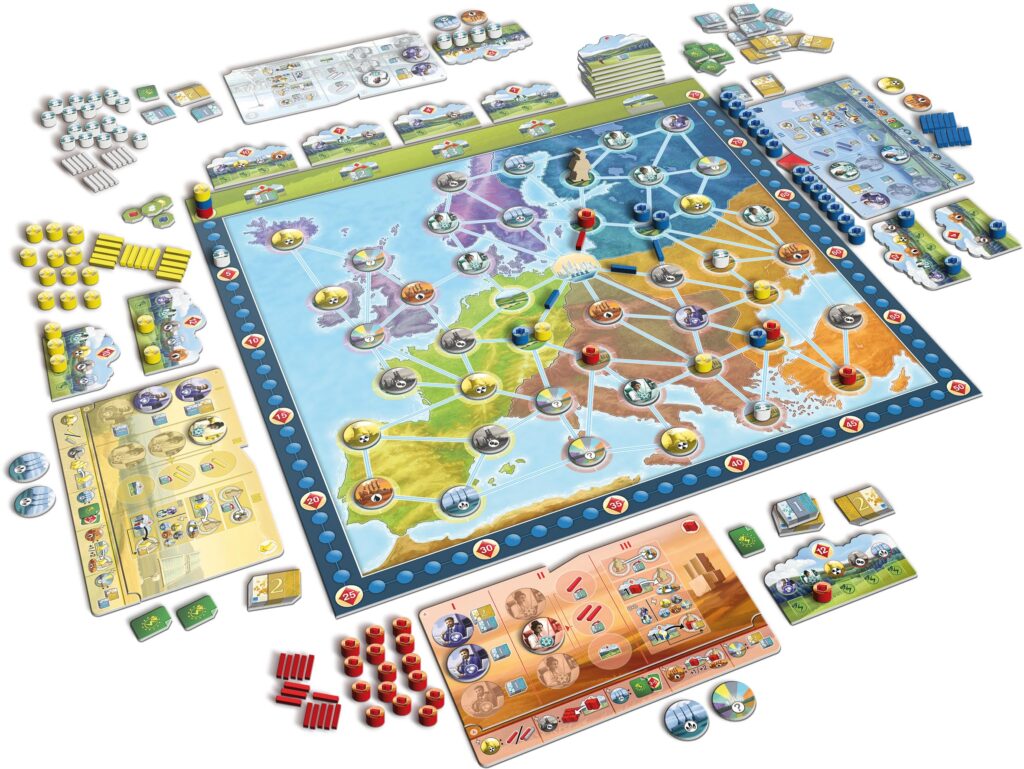
In most traditional resource-management games, players build factories on blank spaces or ‘extract’ resources from the in-game environment. Future Energy presents a more realistic dilemma, i.e. not having a ‘blank canvas’ but an entrenched, outdated fossil fuel infrastructure. The board is pre-populated with action tiles representing old, inefficient power plants, specifically coal, natural gas, oil, and traditional nuclear plants. To make progress, players must guide a construction crew across Europe to shut down these old facilities. Only when a legacy power plant is decommissioned can a player replace it with a renewable alternative from their contract board, such as wind, solar, hydrogen, or fusion power. This highlights the expensive and messy dismantling of fossil fuel infrastructures rather than the more immediately gratifying production of new clean power sources.
A major bottleneck in the real-world green transition is the power grid. Renewable energy sources like offshore wind or remote solar plants are often far away from the cities that need them, necessitating an upgraded electrical grid. Players spend capital to establish networks of modern power lines connecting cities across European regions. A key mechanic requires players to share a single, communal construction surveyor figure to build plants. If a player wants to move the crew across a pathway owned by an opponent to reach a prime construction site, they must pay that opponent a transit fee. This highlights that a sustainable future relies on a shared, robust infrastructure but also symbolizes the economic interdependences (and potentially conflicting economic interests and ambitions) involved in modernizing trans-national energy networks.
Instead of relying solely on money, the game introduces environmental policy mechanisms as an additional form of currency. By shutting down old power plants with efficient timing and fulfilling municipal construction contracts, players earn CO2 certificates alongside regular money. These certificates are important resources used to bid on and acquire future high-value construction contracts. Thus, Future Energy ‘gamifies’ the carbon credit and cap-and-trade systems but also, implicitly, demonstrates how inherently game-like these systems already are and how they may afford or even incentivize ‘system gaming’.
The game does not reward ‘spamming’ a single type of energy in one location but instead incentivizes geographical balance. During final scoring, players are awarded substantial bonus victory points based on area majority, i.e. having the most plants in a specific European zone, and the scale of their largest connected grid network spanning multiple distinct national regions. This mirrors the contingencies of grid resilience; because renewable energy can be intermittent, a sustainable European energy future requires a wide, geographically interconnected net to balance energy demand across an entire continent.
From a mechanical standpoint, Future Energy is a re-implementation of an older 2017 Queen Games title called Pioneers. In Pioneers, players represent Western settlers moving a stagecoach across America to deploy pioneer meeples symbolizing bankers, miners and farmers into towns. Because the core gameplay is adapted from (arguably) a colonization-informed game, Future Energy similarly leans heavily into economic efficiency and route-building rather than e.g. ecological or social complexities of the energy transition. There are no climate disasters, rising temperatures, or pollution tracks that could e.g. cause a collective ‘lose state’, which is why the game represents sustainability through a somewhat techno-optimist, corporate and logistical lens, suggesting that a sustainable energy future is a difficult but also potentially highly lucrative infrastructure project.