

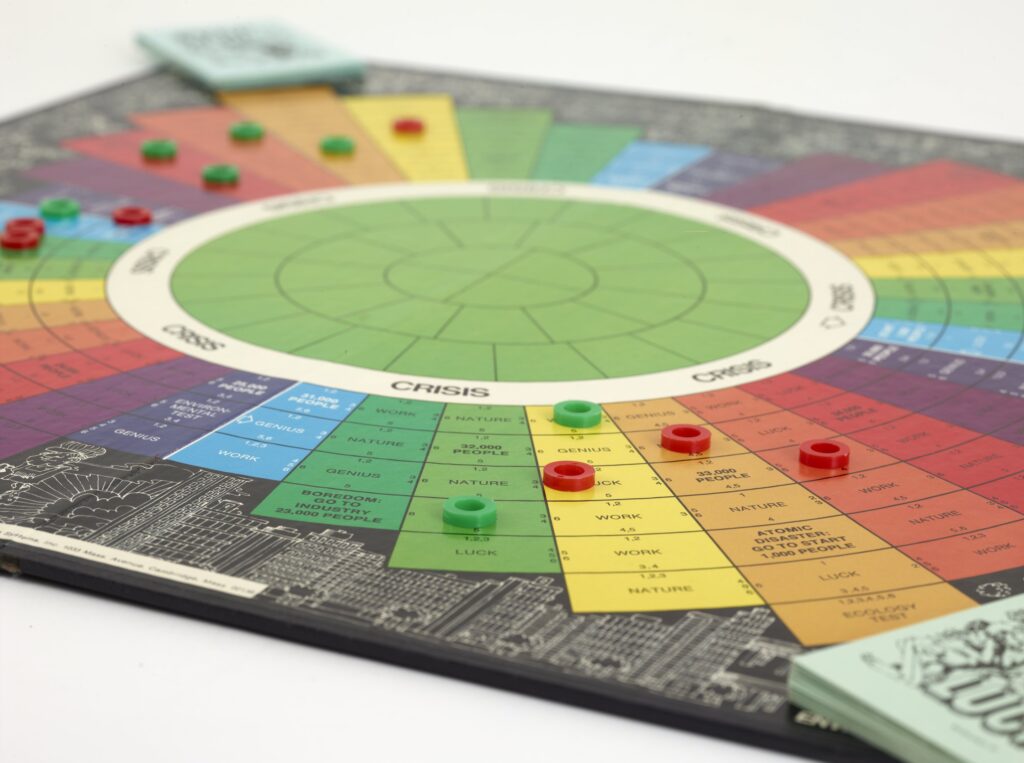
From the Science History Institute website: “Ecology: The Game of Man and Nature was published in 1970 by Urban Systems, a consulting and research firm, whose president, Richard H. Rosen, was an ecologist and environmental engineer. While teaching undergraduate air pollution classes at Harvard, Rosen produced a number of anti-pollution board games for educational purposes. The board game comprises a stack of paper play money, 20 Luck cards, 21 Work cards, 24 Genius cards, 208 paper point tokens, 139 plastic rings, and 2 chart cards. The object of the game is to lead a population through four ages of Civilization, Hunting, Agricultural, Industrial, and Atomic, to reach an ideal Environmental Age.”
The game acts as a playable critique of human-nature relations, directly reflecting the eco-anxieties and shifting environmental paradigms of the early 1970s. It presents humanity’s relationship with nature through a linear historical progression where players must guide a population through various societal milestones.
The game board and core structure represent human history not as a triumph of political or economic power, but as a shifting relationship with the natural world. Players must advance their populations through four distinct historical eras to reach a hypothetical utopian finale. The ultimate goal and winning condition of the game is not to amass the most wealth, but to survive the systemic crises of the first four eras and achieve structural equilibrium, leading into a final “environmental age.”
Humanity’s connection to nature shifts from dependency (Hunting/Agricultural) to aggressive domination (Industrial/Atomic), and finally to stewardship (Environmental). Progressing through the early stages requires exploiting natural assets, but moving past the Industrial and Atomic phases requires players to actively solve the systemic repercussions of that exploitation.
The game visually models sustainability by using physical tracking components that create explicit numerical tradeoffs between human growth and ecological capacity. The Players manage concrete quantities of population units, production units, and ecology points using plastic rings and tokens. To generate money and support a growing population, players must build up their agricultural and industrial production. However, if human population growth outpaces the number of active ecology points in a player’s zone, it triggers a state of ecological deficit. Players quickly realize that unchecked growth, a pillar of many traditional board games, exceeds the ‘carrying capacity’ of the system. Wealth cannot protect a player if their underlying population lacks the ecological foundation required to sustain them.
The game represents environmentalism not as an innate moral choice, but as an historically and practical necessity, an operational defense against technology-driven ecological devastation. Specialized card decks (Luck, Work, and Genius decks) introduce real-world factors into the simulation. During the Industrial and Atomic ages, landing on certain spaces or drawing specific cards simulates industrial accidents, toxic accumulation, and overpopulation crises. The “Genius” cards represent technological breakthroughs, but the game balances them by having new technologies often introduce unintended environmental side effects. To overcome these penalties, players cannot simply pay their way out with money; they must pivot their strategy toward restoration, sacrificing immediate economic expansion to buy back “ecology points” and restore balance.
Framing the “Environmental Age” as the pinnacle of human advancement, occurring after the Atomic Age, feels like an outdated but – maybe therefore – charmingly hopeful sentiment that connects contemporary players with the early phase of the environmental movement in the US more than 50 year ago. Therefore, the game can sensitize players towards how long interactive media have advocated ecological reasoning, how our contemporary viewpoints compare to early-day environmentalism and which aspects we might want to preserve or revitalize.