

The Minecraft Ecology Mod simulates environmental and ecological phenomena by turning the player’s core survival behavior into an active driver of pollution, which then triggers realistic environmental feedback loops. Rather than treating the environment as the usual infinite, consequence-free resource sandbox, the mod tracks pollution dynamically across the map, forcing players to think about their ecological impact.
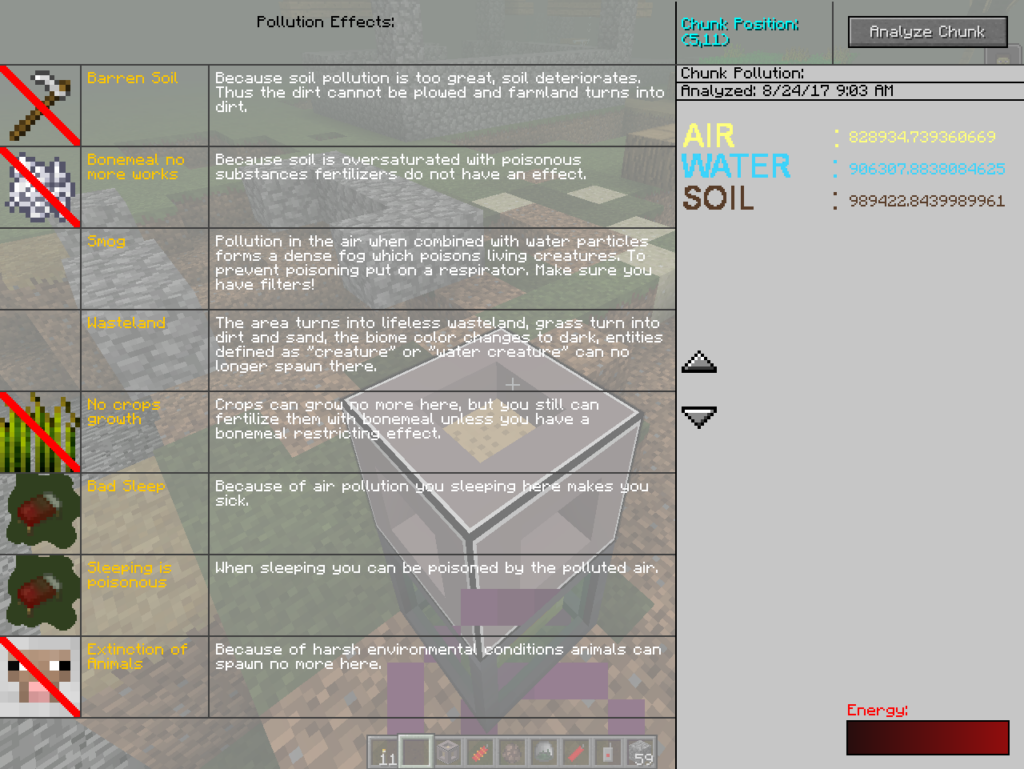
The mod treats pollution as an invisible, fluid state that accumulates within individual 16×16 chunks in Minecraft. Instead of staying completely localized, the system simulates atmospheric dispersion as pollution generated in one chunk will slowly diffuse into neighboring chunks over time. This means that if the player builds a massive industrial hub, the toxic air will eventually poison the surrounding forests or plains. When using a crafted item called an Analyzer, it reads the current air quality and displays active environmental debuffs, allowing to track how far a factory’s pollution has spread.
The mod links traditional Minecraft survival mechanics directly to environmental degradation. Actions that are usually beneficial in standard gameplay become carbon-emitting or even destructive. Melting iron ore or cooking food in a standard furnace emits pollution into the chunk; similarly, leaving open campfires burning permanently degrades the local air. Relying heavily on TNT for mining or clearing space creates massive spikes in local debris. Simulating real-world littering and landfill effects, dropping items on the floor and letting them despawn naturally adds a small amount of waste pollution to that chunk.
When pollution in a chunk reaches certain thresholds, the mod triggers cascading ecological disasters, forcing the player to adapt over time. High air pollution triggers a thick, poisonous fog (smog) that severely reduces visibility. If it rains while the chunk is highly polluted, it turns into Acid Rain, which burns players and damages the landscape. Trees act as natural carbon sinks, but they cannot survive heavy toxicity. If pollution levels peak, nearby trees will die and decay, and saplings will refuse to grow, stripping the area of natural filtration. High pollution thus directly threatens biodiversity. Farm animals like cows or pigs and fish populations in polluted waters will gradually stop reproducing and die out, forcing players to relocate food production away from industrial zones. Crops grown in highly polluted chunks become tainted. Consuming harvested wheat, carrots, or potatoes from these areas can give the player negative status effects like hunger or poison.
To counter these simulated climate disasters, the mod introduces mechanics modeled after sustainable practices and technologies. The most basic way to clean a chunk is by utilizing nature. Planting trees and allowing them to grow actively absorbs pollution from the air, introducing a natural counterweight. For heavy factory setups, players can craft a Pollution Filter or an Advanced Filter. These blocks consume energy to actively scrub pollution out of the chunk’s atmosphere. If a chunk becomes completely unlivable, players must craft a gas mask to safely breathe and navigate through the poisonous smog without taking damage. While these simulated effects can be quite effective due to the sandbox gameplay, it is worth considering that they may also propagate techno-optimism as most climate threats have viable (if sometimes cumbersome) countermeasures that cannot fully fail to work. Moreover, mitigating climate effects of production is also possible if diagnosed at a later stage, which may not be fully realistic but does create a sense of agency if applied to real-world contexts.