

TTRPG Scenario
Chloé Germaine and James Louis Smith. The Gauntlet, 2022. Published in The Between Season 3.
3–5 players including a Game Master | 2–4 hours | Adult
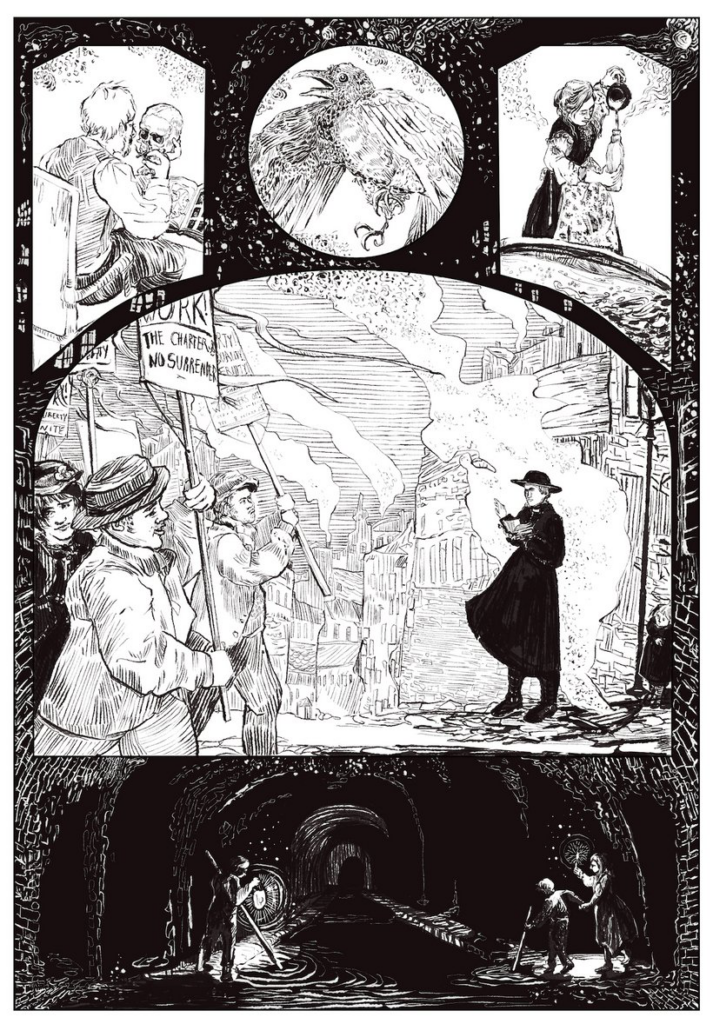
The Miasma of Miswell Hill is a scenario for The Between, Jason Cordova’s tabletop roleplaying game of Victorian monster-hunting published by the Gauntlet. In The Between, players take the role of investigators based at Hargrave House, tasked with neutralising supernatural threats in a London that Scotland Yard cannot or will not address. In this scenario, the investigators are dispatched to Miswell Hill, a densely populated working-class rookery, a labyrinth of crumbling slums, blind alleys, and stinking culverts, following the disappearance of a clergyman sent to investigate a toxic fog that rises from the drains and appears to kill those it envelops. The central question the scenario poses is whether the Miasma is of human or non-human origin, with two branching resolution paths: exposing a dastardly industrial scheme, or befriending, banishing, or pacifying a vengeful non-human entity, the spirit of the suppressed underground river, Tamesas, mother of rivers. The scenario is populated with historically resonant characters including Chartist organisers, a pseudoscientific eugenicist, and a Prussian surveyor compiling notes on the conditions of the working class for a forthcoming manifesto.
The Miasma of Miswell Hill situates ecological harm at the intersection of industrial capitalism and class exploitation, resisting the tendency in Victorian Gothic horror to displace environmental damage onto the supernatural. The Miasma is ambiguous by design: it may be the product of industrial pollution — toxic dyes from an upriver mill, pseudo-scientific experimentation on the bodies of the poor — or the rage of a pre-modern river deity whose course has been bricked over, profaned, and driven underground by the expanding city. In either case, the scenario refuses to separate ecological from social harm: the rookery’s residents are exposed to the Miasma precisely because they are economically marginalised, and the forces that poison the land are the same forces that exploit its workers. This connection is built into the scenario’s ‘Moments’, which are brief sensory prompts for the GM that make visible the non-human lives entangled in the rookery: the briefly emergent underground stream, the dead raven, the pigs in their bare backyard with ‘intelligence palpable in their eyes.’ The non-human origin path is particularly ecologically generative: the Stone of Tamesas, awarded if the river entity is befriended rather than defeated, gives the investigator the ability to commune with London’s rivers, positioning the waterways as agents with memory, grievance, and knowledge rather than as resources or hazards. The Miasma itself is described as ‘near-sentient’, capable of ambush and pursuit, and its inhalation transmits ‘alien feelings of anger and resentment at the mistreatment of the natural world’, making the body of the investigator a site of ecological contact and unwilling empathy. Mechanically, the scenario embeds this in The Between‘s branching Question structure, which requires investigators to move through layers of complexity before resolution, slowing down the extractive logic of the monster-hunt and replacing it with interpretive attentiveness to the entangled human and more-than-human histories of the landscape. This is ecohorror that, in the terms developed by Timothy Morton (2016), generates ‘dark ecology’ rather than ecophobia: the scenario does not position nature as a monster to be defeated, but as a damaged world that players must learn to read, respond to, and take responsibility within.
References
- Estok, S. 2018. The Ecophobia Hypothesis. London: Routledge.
- Germaine, C. 2023. ‘Dark Forests and Doomed Adventurers: An Ecocritical Reading of Horror Roleplaying Games’. In Torner, E. et al. (eds.) GENeration Analog 2021 Proceedings. Pittsburgh: ETC Press, pp. 129–139.
- Morton, T. 2016. Dark Ecology: For a Logic of Future Coexistence. New York: Columbia University Press.