

BOSK. Daryl Andrews and Erica Bouyouris. Art by Kwanchai Moriya. Floodgate Games, 2019.
2-4 Players | 20-40 minutes | Age 13+
Adapted from the Ecogame Ludography
Bosk is a competitive area-control game set in a US national park in which players plant trees so that their falling leaves will dominate particular areas of the parkland and score victory points. ‘Bosk’ is a Middle-English word for thicket or wooded area and its etymology traces back to proto-Germanic languages. As Wohlleben notes, the early Germanic words for tree offer a possible root for the word ‘book’ (2021: 111-112), suggesting a connection between nature and culture made apparent in this game and other recent games that are interested in forests and trees, of which several appear in this ludography. In Bosk, ‘natural’ seasons are translated into game rounds and gameplay takes place over the course of a year in the national park. The objective of the game is to score points in Summer and Winter via the careful placement of each player’s species of tree. In spring, players grow their trees tall, taking it in turn to place their trees along the trails. In summer, the value of each tree is added across each column and row, with the dominant species taking victory points. In Winter, the winds blow and leaves fall from the trees. The wind direction changes each round, demanding that players pay attention to the drifting leaves so that they can dominate a particular area of the forest, designated by coloured spaces representing different ecosystemic areas in the park (such as the river, the plains, etc.).
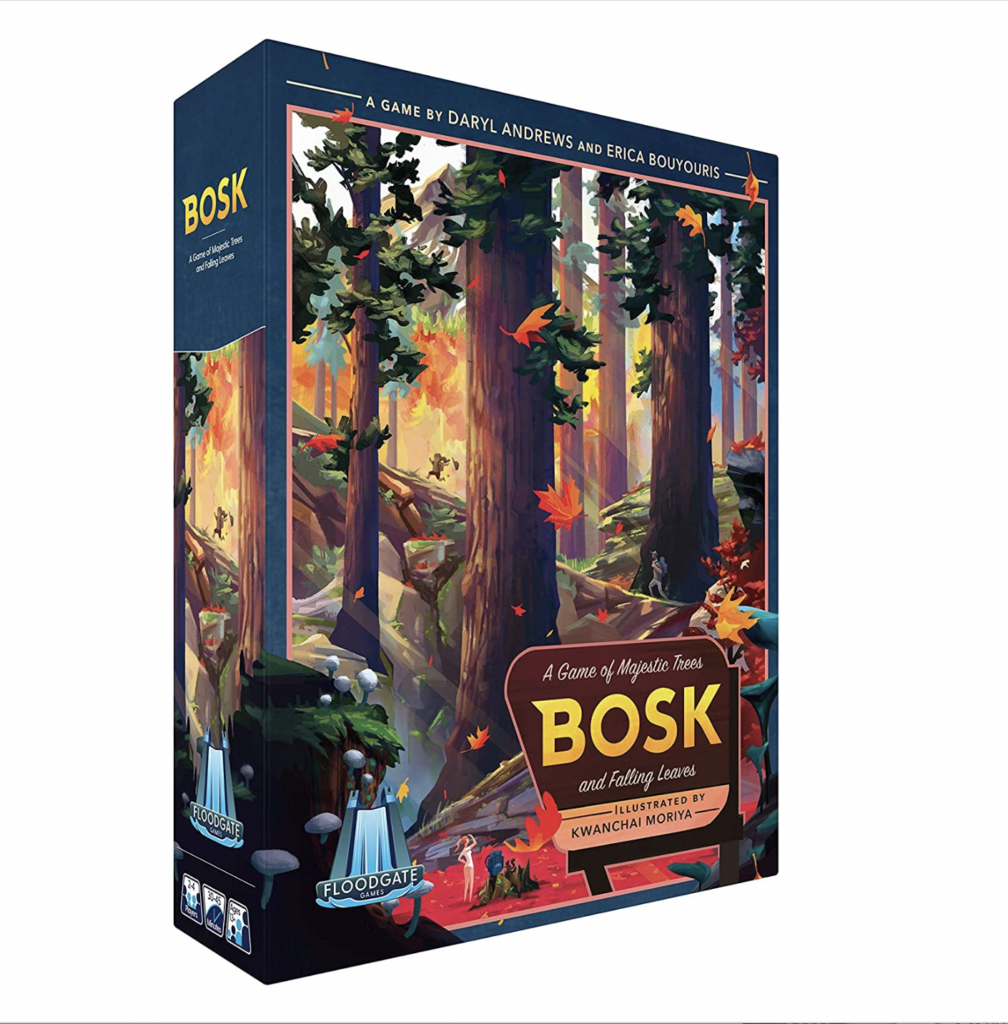
Unlike its competitor, Photosynthesis, with which this game shares some aesthetic features, Bosk does not claim to simulate botanical processes; the life cycle element of the game instead centres on the value of each tree to the beauty of the national park, and their value is linked to the interest of human visitors. This is overtly represented by the first player marker — the hiker — who is used to track scoring in summer as it wanders the trail paths and admires the tallest trees. In its mechanics and goals, the game thus codifies the fact that seemingly ‘natural’ landscapes are managed by humans according to human tastes and interests. As Wohlleben discusses, for example, the trees of national parks in British Columbia are planted according to a landscape aesthetic designed to appeal to tourists, rather than in such a way that will encourage biodiversity and the health of the forest (2021: 185).
The other anthropocentric aspect of the game emerges from the way it encourages direct competition by species of trees. The goal is to become the dominant species whose falling leaves will cover those of the other trees. In our session, this encouraged aggressive play and suggested that the natural world is a site of zero-sum competition rather than a network of symbiotic and mutualistic relationships.
Content created by Seth Etchells, Charlotte Gislam, Lucy Roberts, Chloé Wake, Paul Wake, and Jack Warren.
References
Wohlleben, P. 2021. The Heartbeat of Trees. Translated by Jane Billinghurst. London: William Collins.