

Social Choice Mirror
Refers to in-game systems that enable players to compare their actions and choices with a (preferably real but also, to a lesser degree, virtual) ‘public’. This social confirmation habit is a powerful behavioral principle that can potentially be used to reinforce environmentally conscious decisions (e.g. individual consumer choices) but also to call into question unsustainable behavior if it doesn’t align with other players or in-game characters as reflector figures.
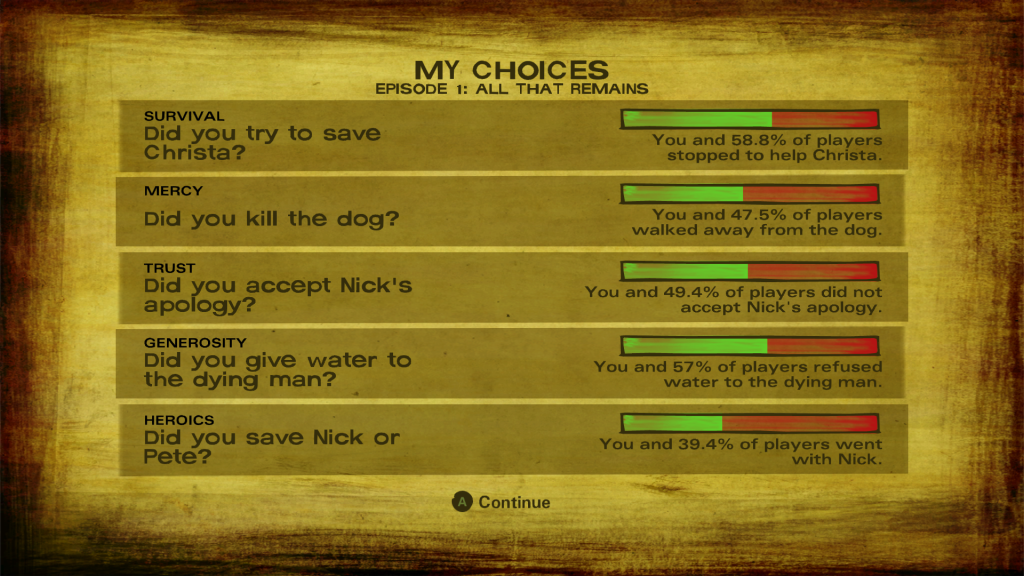
For example, at the end of a game episode or session in The Walking Dead, players are presented with a moment of reflection, where they can see how their choices throughout the game compare to those of other players. A message might appear saying, “You chose to take the risky path. 45% of players made the same decision.” This subtle influence, especially when players feel uncertain about their actions, can significantly impact how they view their in-game values and decisions. When players see how their choices/actions align with or differ from the majority, it evokes descriptive norms, where people look at what most others do to figure out what is “normal” or acceptable in this context. If most players made a different choice, it might make the player second-guess their decision, causing them to reconsider their reasoning, feel regret, or question whether they made the best choice. This feedback also connects to social proof. When the “right” choice is unclear, like in tough decisions or eco-related choices, seeing what others did can help guide players. It nudges them to follow the group, making the majority’s choice seem like the best or most logical option.
Applying this design pattern of social comparison and feedback may lead players to reflect on their decisions, increasing their self-awareness and critical thinking. However, it can also create doubt or regret if players see that the majority made a different choice, triggering cognitive dissonance, a feeling of mental discomfort caused by holding conflicting views, like believing you did the right thing but seeing most others chose differently. In morally ambiguous situations, this pattern can guide players but might reduce their sense of agency, the feeling of control and independence over their decisions, if they feel compelled to follow the group.
When applying this pattern, designers need to decide how to present feedback (through percentages, visuals, or narrative summaries) and how much emphasis to place on the majority’s actions, as strong emphasis can increase emotional impact but also risk pressuring players to conform. The Walking Dead highlights whether the player’s decisions match the majority, especially after emotionally or morally difficult choices. These comparisons can be powerful, as players often face situations where no option feels right. Seeing how others chose in those moments can spark doubt, guilt, or validation, especially when your choice led to someone getting hurt or worse, despite good intentions. In contrast, Detroit: Become Human presents similar comparisons more as a reflection on the player’s personal journey, without emphasising majority decisions as “right” or “wrong.” The focus lies on how choices impact the game’s narrative and the relationships between characters, giving players room to reflect on their decisions without feeling pressured to conform to the majority. Frostpunk, while not showing direct comparisons to other players, implements a version of this pattern through in-game consequences and citizen reactions, prompting players to question the morality of their choices and reflect on their leadership under extreme conditions.
Related Patterns
Superior patterns: –
Subpatterns: Consequence Feedback, Player Reflection
Conflicting patterns
Delayed Consequences